
Mr. Tuesday
By Jeff Eckenrode

He came in every Tuesday at a quarter past two. You could hear him before you saw him: the squeak of the tennis balls on his walker, two short notes and a pause, all the way from the door to the counter.
He was tall, or had been, and stood as straight as the walker would let him, like a heron that had agreed to use a cane. His beard was white and long, combed every morning to the middle of his chest, and a pair of small round tortoiseshell glasses sat low on his nose so he could look over them at you. Rain or shine he wore the same faded navy raincoat, belted, older than most of the shop, and a tweed cap he tipped to Berny on the way in.
Same order every time. One tincture. One gummy, which he called his “treat for when I get home.” Then he’d lean on the walker and ask Pete about the weather, even when the weather was right there in the window, and Pete would tell him, in detail, like it was breaking news.
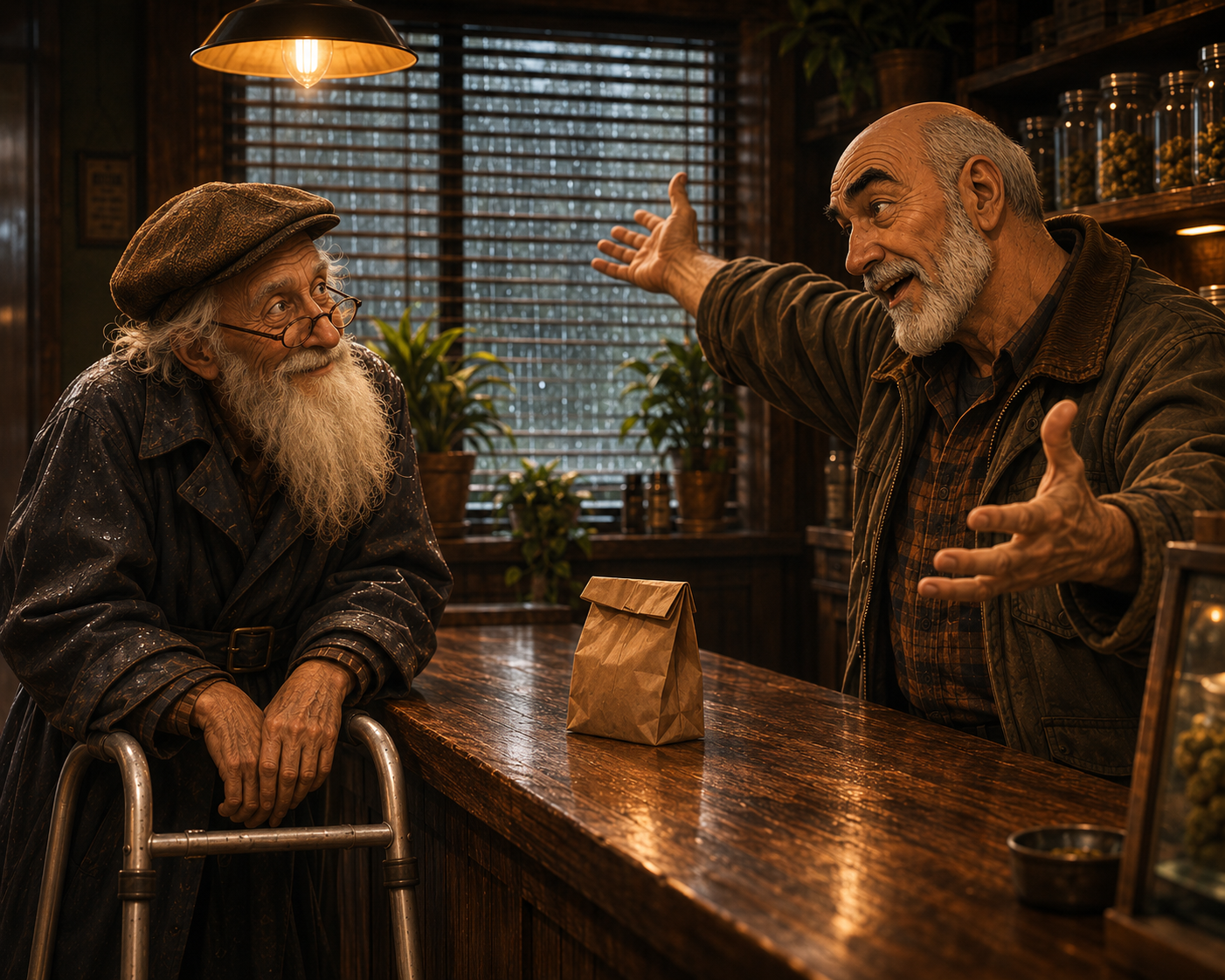
Nobody knew his name. Berny called him Mr. Tuesday. Then everybody did.
The first Tuesday he didn’t come, Berny noticed at half past two. She looked at the clock, then the door, then the clock again, like one of them might change its mind.
“He’s never late,” she said. “Not once in three years.”
“Bank job,” Pete said. He put both hands on an invisible steering wheel at ten and two and checked an invisible mirror. “Knocked over a credit union. Getaway car doing a steady twenty-five.” He leaned slowly into a turn. “Signaled the whole way. Nobody’d ever suspect him.”
“Pete,” Berny said, arms folded.
“Full stop at every sign, Bern. Cops drove right past.”
Berny turned to me with the look she gets right before she asks me to care about something.
“Those jars aren’t going to count themselves,” I said.

The second Tuesday, Berny was at the window by ten past two.
“Do any of us know his real name?” she asked. “If we knew his name, we could call around. Make sure he’s all right.”
None of us did. She looked at me like I was supposed to.
“He’s a grown man,” I said. “He doesn’t need to check in.”
“He’s a grown man with a walker who hasn’t been here in two weeks.”
Pete glanced over one shoulder, then the other. He pressed a finger under his nose like a mustache and talked out of the side of his mouth. “Witness protection. They got him in Arizona now. New name. New mustache.”
“He’d never shave that beard,” Berny said. “It’s too distinguished.”
“Mustache goes on top of the beard, Bern. That’s the disguise.”
I handed Pete the clipboard. “The audit.”
The third Tuesday, Berny set his order aside under the counter, tincture and gummy, in a little paper bag with a T on it. Every time she passed it, she straightened it.
Pete held out one hand to nobody, bowed, and swept an invisible partner into a slow turn down the aisle, humming something that wanted to be a waltz. “Eloped,” he said, mid-twirl. “Found himself a sweetheart down at the senior center and ran off into the sunset.” He dipped her. She was apparently quite tall.

“Then he’d have sent you a postcard,” Berny said. “About the weather.”
Pete stayed bent over his invisible partner for a long moment. Then he stood her back up. “Well,” he said. “She’s got me there.”
I was in the back office doing a count for a delivery I knew was all there. I didn’t look at the clock. I knew when it was a quarter past two anyway, because the hallway was quiet in a specific way.
The fourth Tuesday, Pete didn’t have a theory. He restocked the same shelf twice. Berny straightened the paper bag, then straightened it back.
“The receiving log,” I said, to nobody in particular. Nobody moved.
At 2:14 I came out front to check on something. I don’t remember what.
At a quarter past two, the door opened.
Squeak. Squeak. Pause.
No raincoat. No cap. But the shirt needed no introduction. It was the kind of shirt you could find in the dark: blue parrots, orange hibiscus, a print that hadn’t decided whether it was ocean or sunset and was going to be both. Above all that white beard, his nose was pink and peeling. A plastic lei hung from the handle of his walker, swaying with every step.
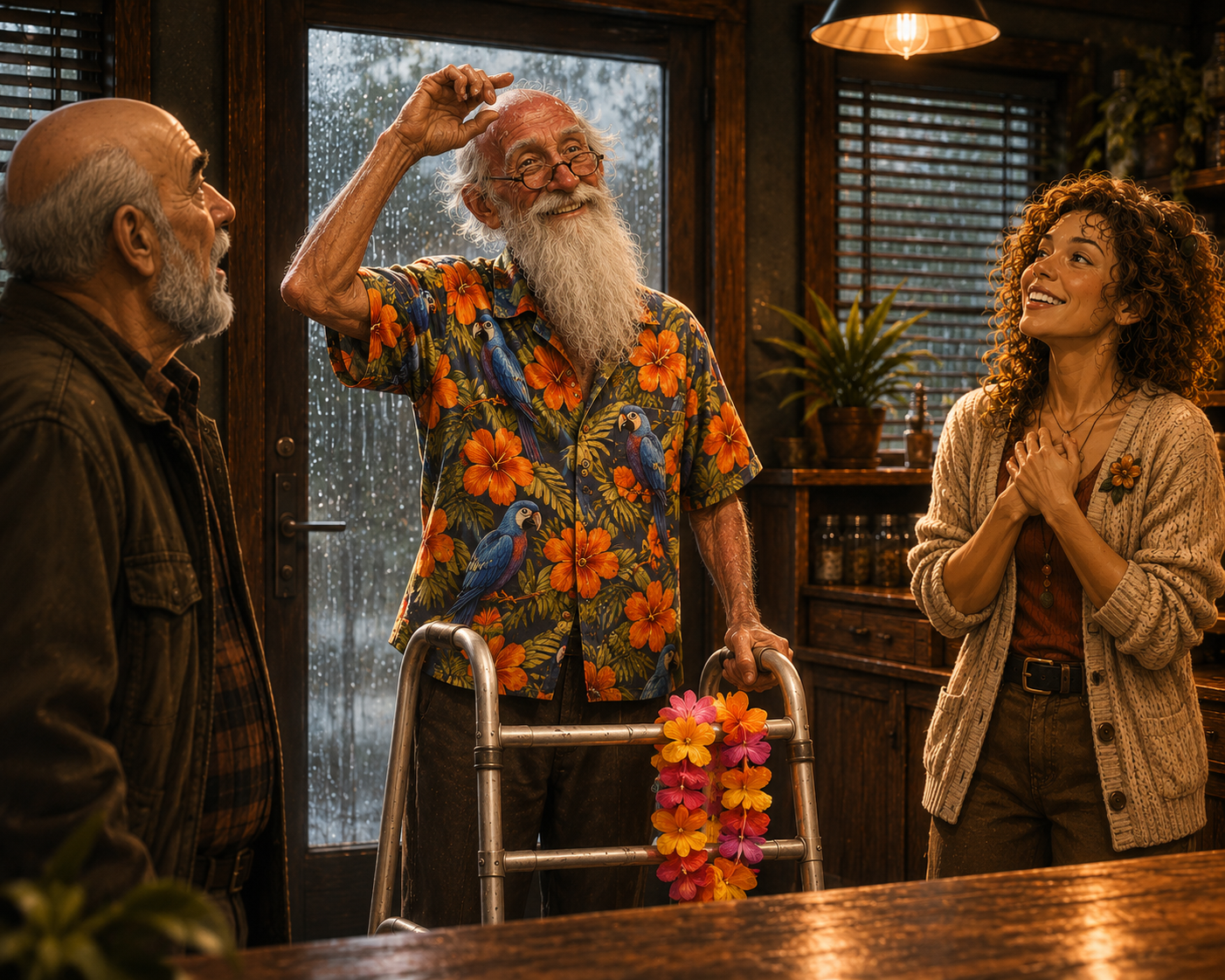
He reached up to tip his cap to Berny, found nothing there, and tipped his hand anyway.
He got to the counter and stopped, grinning so wide it looked like it had been there for a month and he’d stopped noticing.
“I hope you didn’t miss me,” he said, soft as ever. “I went to see the ocean. The warm one.”
Berny made a sound I’d only heard her make at puppies.
“Fifty years I’ve been meaning to go,” he said. “Figured I’d better quit meaning to.” He looked at each of us over his glasses, still grinning. “Life’s for the living, you know.”
Then he reached into his shirt pocket and set something on the counter in front of me. A penny, pressed flat into an oval, a palm tree stamped across what used to be Lincoln.
“Saw it and thought of you,” he said. “Berny told me you like coins.”
It was legal tender run through a machine for fifty-one cents. Nobody who liked coins would want it.
I put it in my pocket.
He turned to Pete. “How’s the weather?”
Pete looked out the window at the rain. Then back at the shirt.
“Tropical,” Pete said.